Showing posts with label soy. Show all posts

Friday, May 16, 2014

CIMB survey, WWF soy report


CIMB recently issued a report on its survey of 3,000 or so of its staff on their cooking oil preferences. The main finding was on health nutrition perception. Do check it out: "Plantations (N) - Opting for healthier cooking oils" noting that "We were slightly surprised that only 43% of respondents in our recent survey picked palm oil as their preferred cooking oil. This could be due to the rising affluence of Malaysian consumers as well as a lack of awareness of the health benefits of palm oil as cooking oil producers may have shifted their marketing activities to other edible oils over the years given that palm-olein-based cooking oil is regulated. The survey reveals that more work may be needed to educate consumers of the health benefits of palm oil. Maintain Neutral on the sector with First Resources as our top pick."

I've downloaded and will be reading with interest WWF's "Soy Report Card - Assessing the use of responsible soy for animal feed in Europe," The broad finding on 88 European retailers, food service companies, CGMs and dairy, meat, egg and feed companies sourcing of soy for animal feed or animal products: "The picture is disappointing. Some frontrunner companies have made strong
commitments to stop sourcing irresponsible soy from recently cleared forests, savannahs and grasslands. They have also started buying “better soy” from producers who adhere to robust responsible production guidelines.... The majority, however, are lagging behind in commitments – and even more in concrete actions such as buying responsible soy. This leaves producers with little incentive to certify their soy as responsible and risks the integrity of some of the world’s most valuable ecosystems, like the Amazon, Cerrado and Chaco."

 
source: WWF Soy Report Card 2014

WWF says: "It’s not only about forests — grasslands and savannahs can also be negatively impacted by irresponsible soy production." It talks about "responsible substitution" or the substitution of imported soy to "build high quality European protein supplies customized for the requirements of the European market and, in some cases, to address the demand from some European consumers for GM-free soybeans and soy protein feed. Examples of such initiatives include Danube Soya...."


Thursday, March 14, 2013

Documentary on soy in Argentina

An interesting documentary on soy in Argentina. The film makers highlight problem of GM soy, using large amounts of pesticide. Argentine doctors interviewed worry that this has resulted in birth defects and childhood cancer in local populations living near soy fields. Soy growers say they are using pesticides the government has approved. Violent encounters over land also a concern.View here: http://www.aljazeera.com/programmes/peopleandpower/2013/03/201331313434142322.html

Tuesday, February 5, 2013

RTRS smartly moves ahead


RTRS is looking more like a market-oriented certification scheme for soy than its cousin, the RSPO is for palm products. Both certification programs are the brainchild of the WWF. Palm oil and soybean oil are key competitors in the edible oil market.

Pertinent points and early news indicates:


a) RTRS is a simpler certification scheme, with areal percentage certified up to each grower to decide vs. RSPO's mandatory 100% areal certification.
b) The RTRS market-oriented approach shows early results with 90+% uptake vs about 50% at RSPO (current and for forseeable future on RSPO's own forecast); and this points to less resource wastage in over-certification. The RSPO suffers a certificate glut problem.
c) It is notable that early shipments are going to a buyer consortium, which points to some concerted marketing effort at RTRS, which is a contrast to the RSPO experience. 
d) Furthermore, the RSPO and its associates appear to be lobbying for higher tariffs against non-RSPO certified palm oil in some key import markets. They seek official acceptance and promotion of the voluntary standard. Could this make "involuntary" what was touted as "voluntary"? If so, this does not serve the interest of non-RSPO members, which are largely small estates and smallholders / farmers. So far, the RSPO's priority and bias has been to promote the largest corporate growers.
e) Note RTRS's tie-up with a consumer market certification for supply chain and its apparent focus on mass balance in its supply chain, ahead of segregation ie. an effort to quickly get RTRS certified soy to market? At the RSPO, the push has been for segregation with inevitable delay and added cost to reach markets, while book & claim and mass balance are seen as temporary options.

News source: 

Monday, July 9, 2012

50% utilization plus excess soybean demand in China?

Khor Reports notes and comments:  

In a report on earnings risks at Wilmar’s “oilseeds & grains” business, by brokerage Kim Eng, dated 5 July, “Times not soy good anymore”, target price: 3.25 on 1.2x p/b some interesting data points: 

a) Soybean crushing utilization at 50% with continued China SOE expansion (apparently to reduce market share of foreign companies ); 

b) anecdotes on soybeans as a form of alternate financing of real estate/ stock market investments over last 2 years (page 4). Does this have some sort of parallel with availability of palm oil below global market prices in China?

Thursday, February 9, 2012

GM crops in 2011


GM crops around the world in 2011 – map; New data from the annual report by the International Service for the Acquisition of Agribiotic Applications shows where farmers are growing GM crops around the world; http://www.guardian.co.uk/environment/graphic/2012/feb/09/gm-crops-world-2011-map?intcmp=122.


Khor Reports comment: Note the large acreage with GM soybean in US, Brazil, Argentina and South Africa; indicated as second to maize.

Monday, October 3, 2011

RSPO vs. soy roundtable

News: GAPKI, the key palm oil producer association of Indonesia withdraws from its membership and its Executive Board role in the RSPO. Source: http://www.rspo.org/?q=content/statement-gapki%E2%80%99s-withdrawal-rspo.

Khor Reports comment: There had been market rumours. Also, the growers' collective dissatisfaction with RSPO is well known. But, seeing is believing. It has happened; Indonesia is following the play book that Brazil has also used. Read about it here in our Khor Reports, Palm Oil Strategic Analysis newsletter #2: https://sites.google.com/site/khorreports2011/palmoil_strat_analysis/khorreport002-palm_oil-rspo_growers-100826.pdf?attredirects=0&d=1.

Since the subject of soy crops up, let's do a quick comparison of some of the key features and achievements of RSPO and its sister organisation in the soy sector, the Roundtable for Responsible Soy (RTRS). RSPO and RTRS have some common Executive Board members - including WWF and Unilever.

Summary info
RTRS: Initiation of consultation in 2004, first certification c. June 2011. Current price of certificates is USD5. 90,500 ha currently certified.
RSPO: Initiation of consultation in 2002, first certification c. end 2008. Current price of certificates is USD1. Over 1 million ha currentl
y certified and 2.6 million ha promised in timebound plans by 2020.

Partial vs. full certification
RTRS: A producer can certify part of his production, but for his entire production area, he needs to implement some fundamental criteria e.g. not to deforest HCVA in non-certified areas. It is up to the producer to determine how much market demand there is for certified soy, so no specific percentage for certification is required (i.e. partial certification is OK).
RSPO: Since Nov 2008, growers have to timetable their adoption plans. Producers have to submit time-bound plans for their certification efforts; they are required to certify all their mills & supply bases (i.e. full / 100% certification is required). Clause 4.2.4 states: “A challenging time-bound plan for certifying all its relevant entities is submitted to the Certification Body (CB) during the first certification audit.” Source: “RSPO Certification Systems, Final document approved by RSPO Executive Board, 26 June 2007, Approved by Executive Board on 3 March 2011 on Revised clause 4.2.4.”

Principles & criteria

RTRS: 5 principles, 28 criteria, 95 indicators.

RSPO: 8 principles, 39 criteria, 118 indicators.

Phase-in compliance

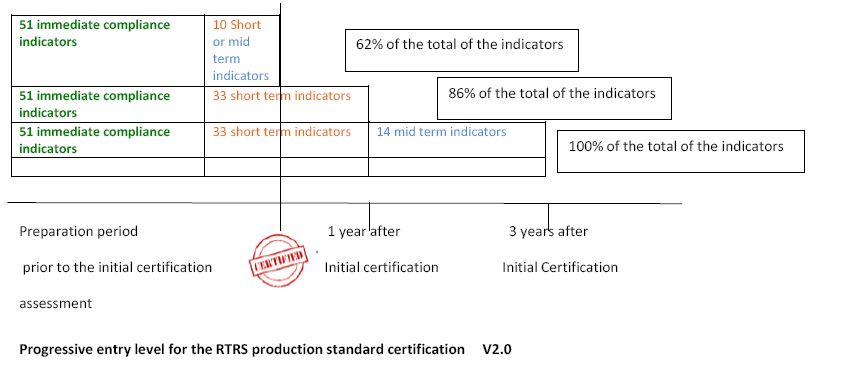
RTRS: Gives producer 3 years to phase-in compliance. Allows partial compliance of 62% in year 1 and 86% in year 2, prior to 100% compliance in year 3.

RSPO: Phase-in not available.


HCV assessments
RTRS: Not required if expansion of soy cultivation is a) in line with an RTRS-approved map and system, or b) in non native forests areas and official land-use maps zone those areas for expansion or c) it is outside priority conservation areas.
RSPO: An HCV assessment, including stakeholder consultation, is conducted prior to any conversion. Also, refer to List of RSPO approved HCV assessors.

A quick glance indicates that on several fronts, RTRS is not as tough as RSPO. RTRS Standards also appears to better drafted, with a better categorisation of the P&C typology - this means fewer overlaps and confusions. When it comes time for RSPO to review its P&Cs (by 2012), it might look to the RTRS as an example.

Despite the more 'business-friendly' look of RTRS (vs. RSPO), Brazil soy association interests withdrew from RTRS. Brazil soy is slated to launch its own industry-led sustainability certification system, called "Soja Plus".