News article, 29 Aug 2011: "Felcra-like model to develop native land in S'wak"
Sarawak has introduced a new land management system modelled after Federal Land Consolidation and Rehabilitation Authority (Felcra) Bhd to develop Native Customary Rights (NCR) land in the state..... According to state land development minister Tan Sri Dr James Masing, the pilot project involving the new land management model was carried out in Pasai Siong, near Sibu......"The agreement with Felcra was reached in June this year. This is the first time we used this model on the NCR land management. This model has been used by Felcra in other land areas under the Ladang Rakyat scheme, but this is the first time it was applied to NCR land.... "This is because, to develop NCR land, you need the consent of landowners. Felcra will manage this pilot project with a fee for 15 years," he said.... under the new land management model, NCR landowners would hold 90% shares, with the remainder to be held by Sarawak Land Custody Development Authority (LCDA). Felcra will source all the funding required and will only charge management and marketing fees.... (source: http://thestar.com.my/news/story.asp?file=/2011/8/29/nation/20110829111929&s)
Khor Reports comments:
a) This is a promising new proposal for NCR land development in Sarawak. This is an advancement from the Sime Darby land deal proposals in FY2009, where the plantation sought a 60% stake, while offering the native landowners 30% and LCDA/Pelita 10%.
b) Previously, oil palm land deals have been in the eastern state of Malaysia have been problematic in their general poor inclusion of native landowners. Such issues are exemplified in the IOI Pelita case where a secondary land purchase has been bogged down by controversy from the initial land deal.
c) This suggests that any plantation should be concerned about the level of inclusion of local and native peoples in their current and existing projects. This "social agenda" is likely to become a significant issue for plantations.
d) Investors in plantations might become more keen to ask plantation companies to better disclose such risks, as well as the conservation / environmental usability and risks of their land banks.
Also view: http://khorreports-palmoil.blogspot.com/2011/04/native-customary-rights-ncr-issues-at.html

This blog highlights news and views on markets, marketing, sustainability and political-economics of palm oil. Any views belong to the respective authors and do not represent that of any particular organization. I update this in my spare time. Since mid-2016, the more "comprehensive" news is available on customized request. Market news and big news continue to be updated. Thank you for reader interest that has generated over 130,000 page views in 2016.
Tuesday, August 30, 2011

Monday, August 1, 2011
Behemoths' land banking efforts stutter?
"Sime Darby’s expansion into Liberia may have hit some road blocks. It was reported that citizens from more than 15 towns and villages near Sime Darby Plantation in Grand Cape Mount County have threatened that the company would face stiff resistance if it intends any further extension of its concession. Not yet known at this point is the size of the area affected as portion to Sime’s 200,000ha concession land." (ECMLibra research report, 18 July 2011)
Khor Reports comments:
a) SE Asian plantations have taken a great interest in West Africa, Papua and other 'tougher' regions, to extend their land banks. Various problems have been reported with these major expansion efforts.
b) Sime Darby is reported facing some resistance from locals in Liberia (article above). The plantation behemoth had also sought to extend its interests in Sarawak, Malaysia, by offering larger stakes to local landholders - but we hear that some of these efforts may have gone 'on hold' for various reasons.
c) Golden Agri is also looking to develop 220,000 ha in Liberia via the USD1.6 billion deal with Golden Veroleum (the land area was initially reported as a 500,000‐acre palm oil plantation in the southeast of the country).3 September 2010: Golden Agri said its “subsidiary Golden VerOleum would form a partnership with the Government of Liberia in a palm oil project… for the cultivation of sustainable palm oil by the company and by Liberian smallholders and farmers, mill processing and value‐added manufacturing…The investment is expected to total USD1.6 billion” (source: http://www.reuters.com/article/2010/09/03/goldenagri‐liberia‐idUSSGC00373720100903). In October 2010. Golden Agri reported it disposed of its entire shareholding comprising one share of HK$1 in Golden Veroleum Limited. A clear status update is needed.
d) Sometime in 2009‐2010, Golden Agri’s “in progress” acquisition of 1 million ha in Papua falls through. Now, players like Wilmar are looking to Papua for major cane sugar projects. Will they have a happier outcome in the low-lying and seawater-flood prone region?
Cargill goes RSPO but keeps smallholders in
Cargill has announced that the palm oil products it supplies to its customers in
Europe, United States, Canada, Australia and New Zealand will be certified by the
RSPO and/or originated from smallholder growers by 2015. This commitment will
be extended across all Cargill's oil and trading businesses to cover 100% of its palm
oil products and all customers worldwide – including China and India – by 2020.
Khor Reports comment:
Cargill includes the smallholder element with the “and/or” flexibility for its sourcing. This seems a tacit acknowledgment that RSPO may have problems including smallholders in its efforts to a significant degree. With Greenpalm certs just bouncing off a meager $1 per unit, it seems hard for smallholders to see monetary compensation for their RSPO certification efforts, unless an attractive program for them is launched soon. The biggest concern we have had with regard to RSPO is its de facto limited inclusion of independent smallholders thus far. We think Cargill’s move is pragmatic and heartening in terms of keeping market access open for these smallholders.
Malaysia criticizes "sinister" campaign against palm oil
The Malaysian Insider reports: “It is utter cruelty to the orang utans. The zoo must understand these are animals from the tropics and adequate protection should be given to them during winter. Their enclosures must be warm and made comfortable,” (Tan Sri Yusof Barison, head of the Malaysia Palm Oil Council) was quoted as saying..... Yusof was reported as saying that he suspects having the orang utans in such degrading captivity was to win public support in Australia in the campaign against the use of palm oil products.... He said having anti-palm oil signs at the zoo was to win public sympathy and to misrepresent the orang utan issue.... “Australians must visit our orang utan sanctuaries in Malaysia and see how well the animals are taken care of. There is something sinister behind the campaign by western NGOs to ruin the palm oil industry,” he said. (Source: http://www.themalaysianinsider.com/malaysia/article/palm-oil-council-chief-upset-over-orang-utan-treatment-in-aussie-zoo/)
Khor Reports comment: The orang utan is a key symbol of the campaigns by NGOs for the sustainable growing of palm oil i.e. without deforestation, peat land development and loss of biodiversity.
Khor Reports comment: The orang utan is a key symbol of the campaigns by NGOs for the sustainable growing of palm oil i.e. without deforestation, peat land development and loss of biodiversity.
Tuesday, July 5, 2011
Trends in planted area for the Top 10

Khor Reports comment: The recent 3-year expansion by the ten largest plantations has averaged some 18,000 ha each year. The annual net increase in their planted area has decelerated from an average of 33,000 to11,300 and 9,300 ha per year. The recent Indonesian moratorium on deforestation has been successfully diluted by corporate and development lobbies. Indonesian planters note that uncertainty surrounding the moratorium had the impact of tamping back their country's 2010 expansion to some 300,000 ha instead of a minimum 500,000 ha per year in prior years (refer to http://khorreports-palmoil.blogspot.com/2011/05/indonesia-moratorium-eases-business-and.html ). Indonesia is widely reported as deforesting at the rate of 1 million ha per year. This implies that oil palm new plantings accounts for half of Indonesia's recent annual deforestation.
Sunday, May 22, 2011
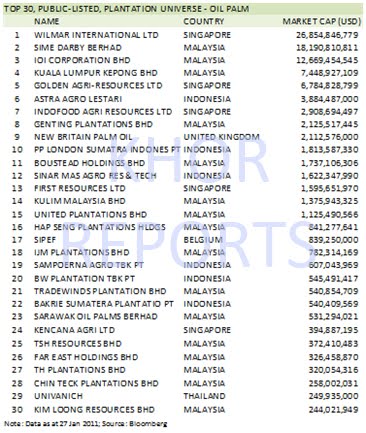
The Top 30
The Top 30 public-listed SE Asian plantation groups, listed by market capitalization:

Source: Khor Reports
Data: Bloomberg, 27 Jan 2011
The aggregate landbank (hectares) for selected top plantation groups (inclusive own estates, smallholder / plasma, interest in joint ventures, and unplanted areas):

Source: Khor Reports
Data: Recent company annual reports
Source: Khor Reports
Data: Bloomberg, 27 Jan 2011
The aggregate landbank (hectares) for selected top plantation groups (inclusive own estates, smallholder / plasma, interest in joint ventures, and unplanted areas):

Source: Khor Reports
Data: Recent company annual reports
Indonesia moratorium eases business and growth concerns
"Moratorium issued to protect primary forests, peatland" May 20, 2011 14:01 PM, The Jakarta Post, http://www.thejakartapost.com/news/2011/05/20/moratorium-issued-protect-primary-forests-peatland.html
Excerpts:
President Susilo Bambang Yudhoyono on Thursday finally signed a policy banning the conversion of primary forest and peatland for two years as part of a government pledge to combat climate change through reducing deforestation..... With the presidential instruction, all local authorities should stop issuing forestry permits, including for plantation and mining companies eyeing businesses in primary forest and peatland areas.
“The moratorium will apply to 64 million hectares of forests across the country,” Agus Purnomo, the President’s aide on climate change issues, said.... However, most of the 64 million hectares .... is located in areas already protected by the 1999 Forestry Law.... “We are double protecting these protected areas since in fact many of these areas are still prone to deforestation. We hope the moratorium will help better protect the forests,” Agus said.
He said businesspeople could still expand into the 34 million hectares categorized as degraded forest areas.... The presidential decree still allows the exploitation of peatland with a depth of less than three meters.
Indonesia has the world’s third-largest expanse of forest with 120 million hectares of rainforest, 40 million of which are protected forest and conservation areas that cannot be exploited for commercial purposes.
According to a letter of intent with Norway, Indonesia is required to stop issuing new permits for exploiting natural forests and peatland within two years.... In return, Indonesia would receive money based on the total amount of carbon emissions reduced within the two years.
Indonesian Environmental Forum (Walhi) senior campaigner Teguh Surya said the government had betrayed its promise to protect forests by only banning the conversion of primary forests and peatland rather than all naturals forests.... “The President ignored input from civil society who care about conserving forests and threw its support to big businesses, such as palm oil plantations,” he told the Post.
.....................................
The business reaction:
"I appealed to the government that non-forest areas should not be included in the moratorium," said Joko Supriyono, secretary general at the Indonesian Palm Oil Association (Gapki). "The impact of the moratorium, even though they postponed the signing, was uncertainty," he told Reuters. He said this uncertainty had led to expansion in 2010 of 300,000 hectares of palm oil plantations in the world's top palm oil producing nation, reduced from a minimum 500,000 hectares in recent years...." Source: Reuters news article.
"Presidential Adviser on climate change, Agus Purnomo said that there would be no new permits on 64 million ha of land in Indonesia. The silver lining is that the moratorium will exempt the extension of old permits, projects given permits in principle by the forestry ministry and issuance of permits to log onsecondary non-peatland forests or convert degraded land. The moratorium will also exempt projects for the development of energy supplies as well as a huge food plantation project in Papua province. We view this development positively as previously, there were worries that the new version of the moratorium may affect plantation companies with “Hak Izin Lokasi” land permits... which is obtained before the “Hak Guna Usaha” (HGU) permit is granted. HGU is land rights granted for 35 years and can be extended for another 25 years. Clearance of land is permitted with “Hak Izin Lokasi”...." Source: "Plantation Sector (Overweight): Indonesia signs moratorium on forest clearing finally," AmResearch, 20 May 2011.
Khor Reports comment:
a) The moratorium was due to start January 2011, but was delayed five months. It is a REDD+ effort to reduce greenhouse gas emissions from deforestation under a USD1 billion deal with Norway. There was widely reported disagreement between the ministries in Indonesia on how extensive the ban on forest clearing should be. The indicators were clear in recent months that a more pro-business stance would likely be adopted.
Businesses will be looking out for land bank:
i) Secondary forest lands for development, including:
34 million hectares categorized as degraded forest areas; and
Peatland with a depth of less than three meters.
ii) Land for development in Papua
b) In 2003, the Indonesian authorities estimated that the potential area for oil palm is 24.5 million hectares. By region, the recent planted (2009) and potential areas are: Sumatra 5.2 and 7.2 million ha (+2); Java 0.02 and 0.3 million ha (+ 0.28), Kalimantan 1.9 and 10.3 million ha (+8.4), Sulawesi 0.2 and 0.4 million ha (+0.2) and Papua 0.06 and 6.3 million ha (+6.24).
c) However, NGO pressures to reduce the rapid expansion of oil palm development in Indonesia have taken their toll. Indonesia's 2-year moratorium on deforestation starts May 2011. It prohibits development on primary forest and deep peat lands (but secondary forest and Papua is exempt from the restriction). The 2003 study likely included areas, which are now considered unsuitable for development for environmental reasons. The potential areas for Kalimantan and Sumatra could be revised down, but those for Papua remain intact.
d) Rapid oil palm development has raised the concern of deforestation in Indonesia. NGOs have been campaigning against new plantings in all types of forested areas and peat lands. While the pro-business outcome of the environment vs. development tussle (over the details of Indonesia's 2-year moratorium on deforestation) may not slow the pace of development by commercial estate owners, successful NGO campaigning with global palm oil buyers such as Nestle and Unilever may have an impact on the largest integrated plantation groups. So far NGO campaigning has been targeted at the top few.
The recent Golden Agri (Sinar Mas) - The Forest Trust deal is noteworthy. The oil palm giant promises not to develop lands with more than 35 tonnes carbon per hectare. Will such voluntary bilateral deals and the efforts of the RSPO hamper expansion efforts of only the largest public-listed groups, or will they extend their reach beyond these to have some real impact on the continued go-go expansion of oil palm hectarage?
Subscribe to:
Posts (Atom)